












Akureyri Iceland sits at the end of a 60-kilometre fjord called Eyjafjörður, and on a clear summer evening the light hits the mountains on both sides in a way that makes the city look much more dramatic than its population of around 20,000 would suggest. It is the second city of Iceland in every practical sense — the largest town outside the capital region, the hub for everything in the north, and the place where you realise Reykjavík is not the whole story.
I drive up here a few times a year, usually along Route 1 through Varmahlíð, and every time I find something I missed before. That is not a polite thing to say — it is genuinely true of a town this size. Here is what I know about it.
Getting to Akureyri from Reykjavík
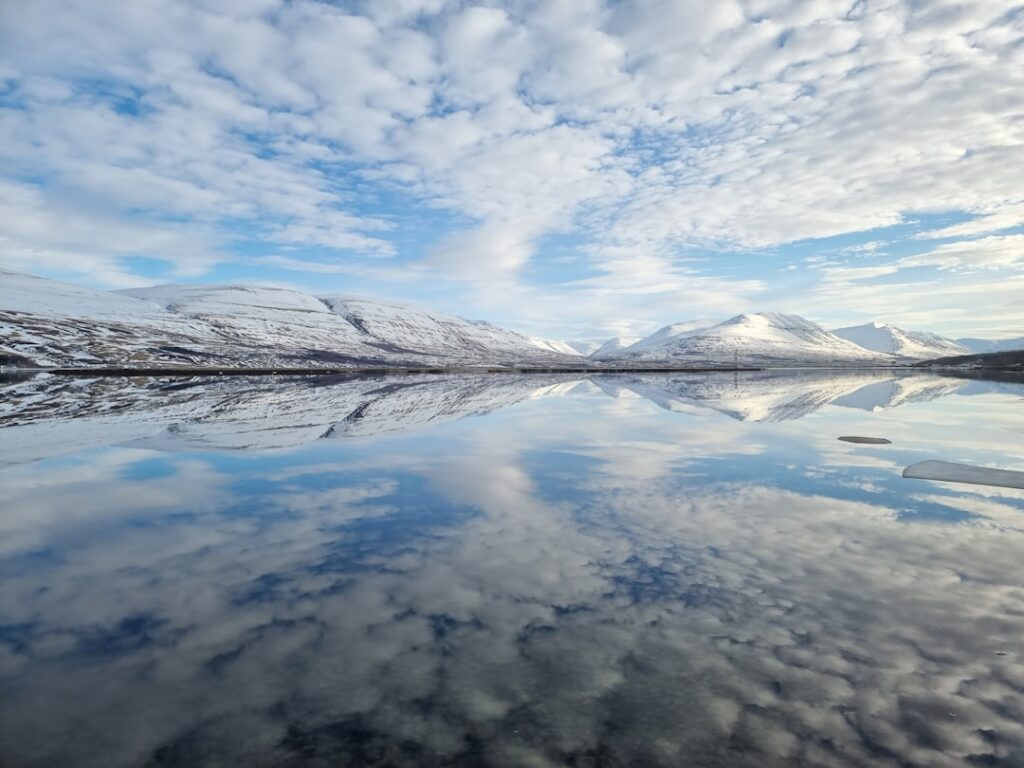
The drive from Reykjavík is around 390 km along the Ring Road. Give it five hours if you are not stopping, which you will be. The road is generally excellent, but in winter you need to check road.is before you leave — the stretch through Holtavörðuheiði can close fast when weather comes in from the north.
Flying is the other serious option. Domestic flights from Reykjavík’s Domestic Airport (Reykjavíkurflugvöllur) to Akureyri Airport take 45 minutes, and Icelandair and Eagle Air run them several times daily. Prices start around 8,000–15,000 ISK (roughly €55–€105) each way if you book ahead. The airport is right inside town — you can walk to the main street in ten minutes.
Strætó runs scheduled bus services north, but they are slow and require connections. Renting a car in Reykjavík and driving is by far the most flexible approach for anyone planning to explore the wider north.
What Akureyri actually looks like
The city slopes down toward Eyjafjörður in a way that gives almost every street a view of the water. The centre is compact — Hafnarstræti and Skipagata are the main commercial streets, and you can walk between most things in under twenty minutes. There are old timber houses painted in dark colours, a botanical garden that is inexplicably lush given the latitude, and a church on a hill that you see from everywhere.
That church is Akureyrarkirkja, designed by Guðjón Samúelsson — the same architect behind Hallgrímskirkja in Reykjavík. It was completed in 1940. The steps up to it are long and steep, but the view back over the fjord is worth the climb even if you have no interest in architecture.
The botanical garden, Lystigarðurinn, is free to enter and genuinely worth an hour. It operates at 65 degrees north, which makes it one of the most northerly botanical gardens in the world. The growing season is short but intense here, and in July the place is thick with colour. I find it oddly moving every time I go.
Where to eat in Akureyri
Rub23 on Kaupvangsstræti is the go-to for fish and sushi, and it has been consistently good every time I have been there. Expect to pay around 4,500–6,500 ISK (€31–€45) for a main course. It gets busy, so booking ahead in summer is not optional.
For something more casual, Bautinn on Hafnarstræti has been feeding locals since 1981 and does solid Icelandic comfort food — lamb soup, fish of the day, burgers that are better than they need to be. Prices are noticeably lower than Reykjavík, which is always a relief.
Café Laut inside the botanical garden is a good lunch stop, and Blái Kannan on Hafnarstræti is the traditional coffee-and-cake place locals actually use. The cinnamon buns are large and not oversweet. If you are there on a weekday morning, the place has a particular unhurried quality that is rare in Iceland’s tourist corridor.
Supermarkets and self-catering
There is a Bónus and a Nettó within easy walking distance of the centre. If you are staying in an apartment or guesthouse with a kitchen, stocking up here before heading into the countryside will save you real money.
Where to stay in Akureyri
Icelandair Hotel Akureyri is the reliable full-service option, centrally located and consistent. Rates in summer run roughly 25,000–35,000 ISK (€175–€245) per night for a double. It books out early in July and August, so plan ahead.
Guesthouse Akureyri — there are several operating under similar names, so read listings carefully — offers more local character at lower prices, typically 15,000–22,000 ISK (€105–€155) for a double with breakfast.
For budget travellers, Strikið Guesthouse and the HI Hostel on Stórholt both have good reputations. The hostel in particular is well-run and has a kitchen, which matters when you are trying to keep costs down in the north.
Day trips from Akureyri worth making
Akureyri is the logical base for most of north Iceland, and the day trips from here are among the best in the country.
Goðafoss
Goðafoss is 50 km east along Route 1, roughly 45 minutes. It is not the tallest waterfall in Iceland, but it may be the most photogenic — wide, curved, completely accessible from the road, and surrounded by dark lava. The historical association matters too: this is where Þorgeir Þorkelsson threw his Norse idols into the water in the year 1000 when Iceland adopted Christianity. Go early morning in summer and you will often have it nearly to yourself.
Mývatn
Lake Mývatn is about 100 km from Akureyri and deserves a full day, or ideally two nights on its own. The volcanic landscape around it — Dimmuborgir, Hverfjall crater, Námaskarð geothermal field — is unlike anywhere else in Iceland. The Mývatn Nature Baths are a good alternative to the Blue Lagoon: similar geothermal experience, far fewer people, around 6,400 ISK (€45) for adults.
Eyjafjörður whale watching
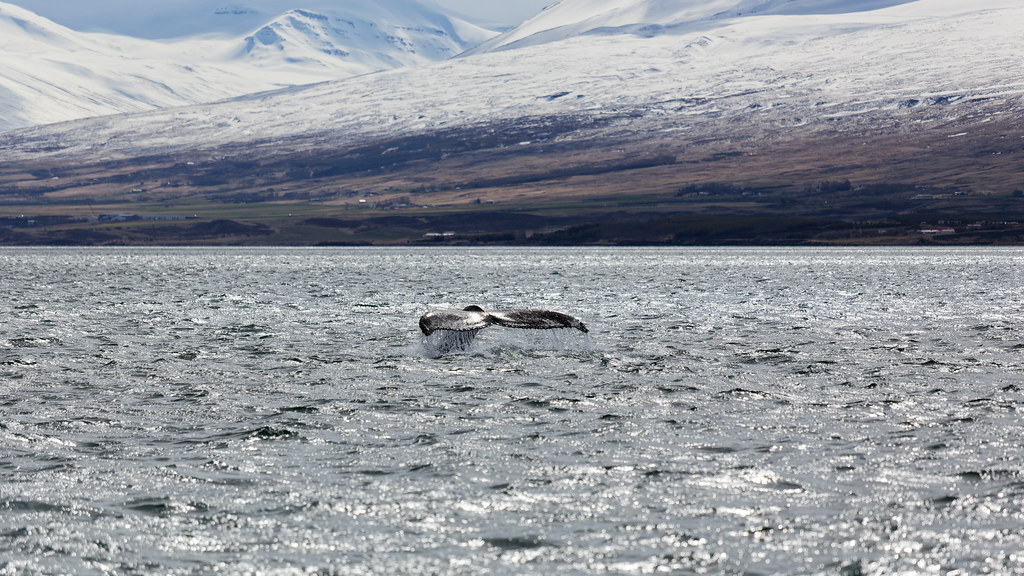
Whale watching from Akureyri’s harbour is one of the better operations in Iceland. Humpbacks and minkes are common in summer, and the fjord setting is different from the open-water tours you get from Húsavík. Tours run around 11,000–12,000 ISK (€75–€85) for three to four hours. Húsavík, 90 km northeast, is the alternative if you want the dedicated whale-watching capital experience — it is a full day trip from Akureyri but entirely doable.
Siglufjörður
Siglufjörður is 75 km northwest, tucked into a narrow fjord that feels like it belongs in a different era. The Síldarminjasafnið — the Herring Era Museum — is genuinely one of the best museums in Iceland and tells the story of the herring boom that made this tiny town briefly one of the busiest fishing ports in Europe. It has won the European Museum of the Year Award. Entry is around 2,500 ISK (€17). The drive through the tunnels under the mountains is quick now, but the old Tröllaskagi mountain road in summer is something else entirely.
Skiing near Akureyri
Hlíðarfjall ski resort is 8 km from the city centre and has runs for all levels. The season typically runs from December through April, and day passes cost around 7,900 ISK (€55) for adults — significantly cheaper than European ski resorts and usually far less crowded. Night skiing is available, and on a clear night you are skiing with the northern lights overhead, which is one of those experiences that is hard to adequately describe.
Akureyri gets notably more snow and colder temperatures than Reykjavík, so skiing here is a realistic activity in a way it rarely is in the southwest.
When to visit Akureyri
Summer — June through August — is when the days are endless and the surrounding countryside is at its greenest. The midnight sun is genuine here; in late June you can read outside at 1 a.m. without any kind of artificial light. The town fills with tourists in July, but it absorbs them better than Reykjavík does because most people are using it as a base rather than staying put.
Winter is underrated. The northern lights viewing around Akureyri is excellent because you are far from Reykjavík’s light pollution and the landscape is flat enough that you can get a clear horizon in multiple directions. The city itself stays lively — people do not hibernate here the way you might expect — and the Christmas lights on the main street run for months. The famous Akureyri heart-shaped traffic lights, which the city installed as a morale boost, are there year-round, but in winter they glow against the dark in a way that is genuinely charming.
September and October offer a middle path: the roads are quiet, the autumn colours in the valley are real, and the northern lights season is building. Accommodation prices drop noticeably from September onward.
Practical things nobody tells you
Parking in the centre is metered but cheap by Reykjavík standards. Most meters run 200–300 ISK (€1.40–€2.10) per hour, and there are free zones a short walk from Hafnarstræti.
The swimming pool — Sundlaug Akureyrar on Þingvallastræti — is excellent, as all Icelandic public pools are, and costs around 1,250 ISK (€9). If you have not done the geothermal pool ritual in Iceland yet, this is a good place to start. It is where locals actually go.
The town’s latitude — 65.7° north — means it is technically above the Arctic Circle if you count the current position of the circle, though the circle has moved slightly south over geological time. Either way, you are genuinely in the north, and the quality of light in summer and the depth of winter darkness both reflect that.
Mobile coverage is good in town but can be patchy in the surrounding fjords and mountain roads. Download offline maps before you head out, and take the weather forecasts from Veðurstofa Íslands seriously — conditions in the north change faster than most visitors expect.
If you are planning a loop of north Iceland, Akureyri is the natural anchor point. Spend at least two nights here before or after the wider circuit — one night is not enough to actually feel the place, and feeling it is the point.