













Earthquake Swarm Continues in Iceland’s Active Volcanic Zones
A series of earthquakes has recently shaken two of Iceland’s most geologically charged areas: the Reykjanes Ridge and the Bárðarbunga volcanic system. Reports indicate that this seismic activity persisted through the night, following an earthquake swarm that began on Saturday, as detailed by RÚV.
What’s the Story?
The ongoing earthquake swarm at Reykjanes Ridge and Bárðarbunga has captured public attention since Saturday. Notably, the strongest tremor registered a magnitude of 3.0, occurring near Geirfugladrang. Over the past 24 hours, multiple earthquakes exceeding magnitude 2.0 have been detected in both regions, marking a significant uptick in seismic activity.
Multiple Tremors Detected
Since the weekend, the landscape has been alive with tremors, with several registering above magnitude 2.0. The most substantial quake, measuring magnitude 3.0, struck approximately 1.8 kilometers northwest of a group of sea stacks known as Vulture Calls, located off Iceland’s southwest coast.
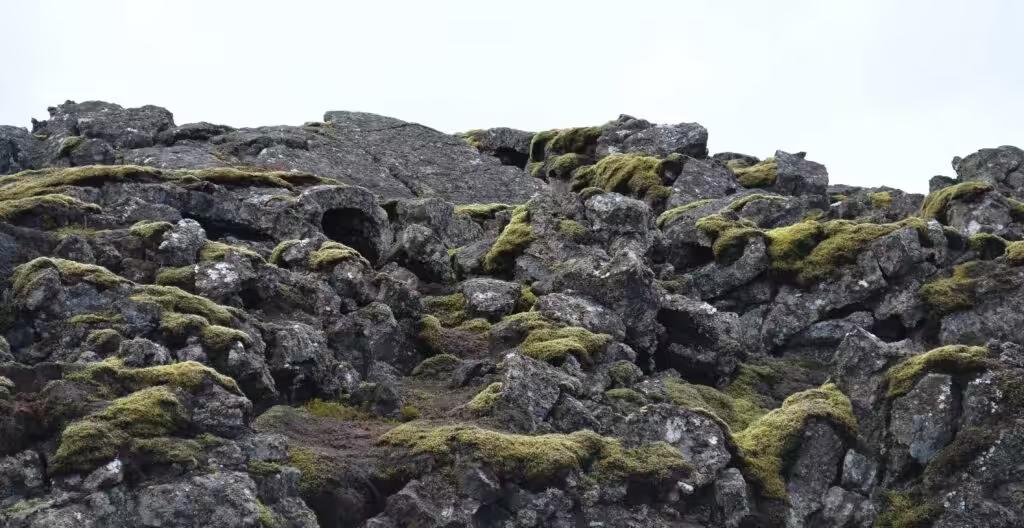
Earthquake swarms like this are a natural part of Iceland’s geological tapestry. The Reykjanes Ridge is a segment of the Mid-Atlantic Ridge, where the Eurasian and North American tectonic plates slowly drift apart, resulting in frequent seismic occurrences.
In recent years, the broader Reykjanes Peninsula has experienced cycles of notable unrest, including volcanic eruptions.
Inland, the Bárðarbunga volcanic system lies beneath the vast Vatnajökull glacier and is renowned as one of Iceland’s largest and most active volcanoes. It boasts a long history of seismic activity, and earthquakes are a common aspect of its ongoing geological processes.
Authorities emphasize that such seismic activity is typical for both the Reykjanes and Bárðarbunga regions, where earthquakes frequently occur.
For many, this event serves as a reminder of Iceland’s dynamic geological landscape, where nature continually redefines the beautiful and rugged terrain.
The post Earthquake Swarm Continues in Iceland’s Active Volcanic Zones appeared first on Iceland Review.