













Canada has confirmed it will join the Eurovision Song Contest, making it the first North American country to compete in the competition’s nearly 70-year history. The announcement, reported by Icelandic outlets Vísir and Morgunblaðið on July 1, 2025, marks a landmark expansion of Eurovision beyond its traditional European and neighbouring boundaries.
Key takeaways
- Canada has officially confirmed it is joining the Eurovision Song Contest.
- Canada is set to compete for the first time at Eurovision 2026.
- Non-European countries can join Eurovision through membership in the European Broadcasting Union (EBU) or by special invitation.
- Australia, Israel, and several other non-European nations already compete in Eurovision.
- Iceland’s Eurovision community is watching the expansion closely, with mixed reactions from fans and broadcasters.
Has Canada officially confirmed it is joining Eurovision?
Yes. Canada has officially confirmed its participation in the Eurovision Song Contest. The country’s public broadcaster reached an agreement with the European Broadcasting Union (EBU), the organisation that oversees Eurovision, to enter the competition. The announcement drew immediate global attention, given Eurovision’s enormous international fanbase and the historic nature of a North American nation joining for the first time.

Icelandic media outlets Vísir and Morgunblaðið both reported the story on July 1, 2025, confirming it as a verified, multi-outlet news event rather than speculation. Social media reacted swiftly, with Eurovision fans worldwide debating what Canada’s entry means for the contest’s future direction.
When would Canada first compete in Eurovision?
Canada is expected to make its Eurovision debut at the 2026 Eurovision Song Contest. The exact host city for Eurovision 2026 has not yet been confirmed at the time of publication, as that depends on the outcome of the 2025 contest. Canada would, under standard Eurovision rules, enter at the semi-final stage in its debut year, unless granted direct Grand Final entry as a guest nation — a precedent set previously with Australia.
If Canada follows Australia’s early entry model, it could be granted an automatic Grand Final spot for its first year as a gesture of goodwill and to maximise audience impact. Officials have not confirmed this arrangement yet, and readers should monitor EBU announcements for updates.
How can a non-European country join Eurovision?
Eurovision is organised by the EBU, a union of public service media organisations. EBU membership is not restricted to European Union countries — it extends to any broadcaster operating within the EBU’s defined geographic area, which includes parts of North Africa, the Middle East, and, by extension through active membership bids, countries further afield.
There are two main routes for non-European countries to participate:
- EBU active membership: A national public broadcaster joins the EBU as an active member, making its country eligible to enter Eurovision.
- Special invitation: The EBU can invite non-member broadcasters to participate as guest nations, as happened with Australia in 2015.
Canada’s entry appears to follow the active membership or associate agreement route, though the precise mechanism has not been fully detailed in early reports. The EBU’s willingness to expand reflects both commercial ambition and the growing global appetite for Eurovision content, driven in large part by streaming platforms that have spread the contest far beyond European television audiences.
Which other non-European countries already participate in Eurovision?
Several non-European countries already compete in Eurovision, so Canada would not be entering entirely uncharted territory. The most prominent examples include:
- Australia — has competed since 2015, initially as a one-off centenary celebration, then on a permanent basis.
- Israel — has competed since 1973, through its membership in the EBU via the Israeli public broadcaster.
- Morocco — competed once, in 1980, as an EBU member broadcaster from North Africa.
- Armenia, Georgia, and Azerbaijan — former Soviet republics that sit geographically in the South Caucasus, outside continental Europe, but participate through EBU membership.
Australia’s long-running participation is the closest precedent to Canada’s situation. However, Canada’s entry is arguably more geographically distant and culturally distinct from Eurovision’s European core than even Australia, making it a bolder expansion move.
What does Iceland think about Canada joining Eurovision?
Iceland has a passionate and proud Eurovision culture. The country’s national broadcaster, RÚV, selects Iceland’s Eurovision entry each year through the beloved Söngvakeppnin competition — a national song contest that draws enormous domestic attention each spring. Reykjavík bars and living rooms fill with viewers on Eurovision final nights, and Iceland has finished second three times in Eurovision history.
Reaction in Iceland to Canada’s entry has been characteristically enthusiastic but layered. Many Icelandic Eurovision fans welcome the expansion, seeing it as proof of the contest’s growing global cultural power. Others express mild concern that broadening the field too far could dilute the European musical identity at Eurovision’s heart.
On social media, Icelandic commentators noted that if Canada brings the same level of production ambition and distinctive national character that Australia has shown, it could strengthen rather than dilute the contest. RÚV has not issued a formal statement on Canada’s entry at time of publication.
For Icelandic and international travellers planning to attend Eurovision 2026 in person, early booking is strongly advised regardless of host city. Eurovision host cities see hotel prices surge dramatically — in Malmö in 2024, central accommodation prices reached several times their normal rate in Eurovision week. Tracking announcements on the official Eurovision website is the most reliable way to stay updated.
What does Canada’s entry mean for Eurovision’s future?
Canada’s confirmation signals that the EBU is actively pursuing a more global Eurovision model. The contest already draws television audiences and streaming viewers across North America, Asia, and beyond — largely through Netflix and YouTube. Formalising that interest by bringing in a North American competitor is a logical commercial step.
But it also raises genuine questions about the contest’s identity. Eurovision has always been, at its core, a European project — born out of post-war efforts to unite the continent through culture and broadcasting. Each new non-European entrant stretches that founding logic a little further.
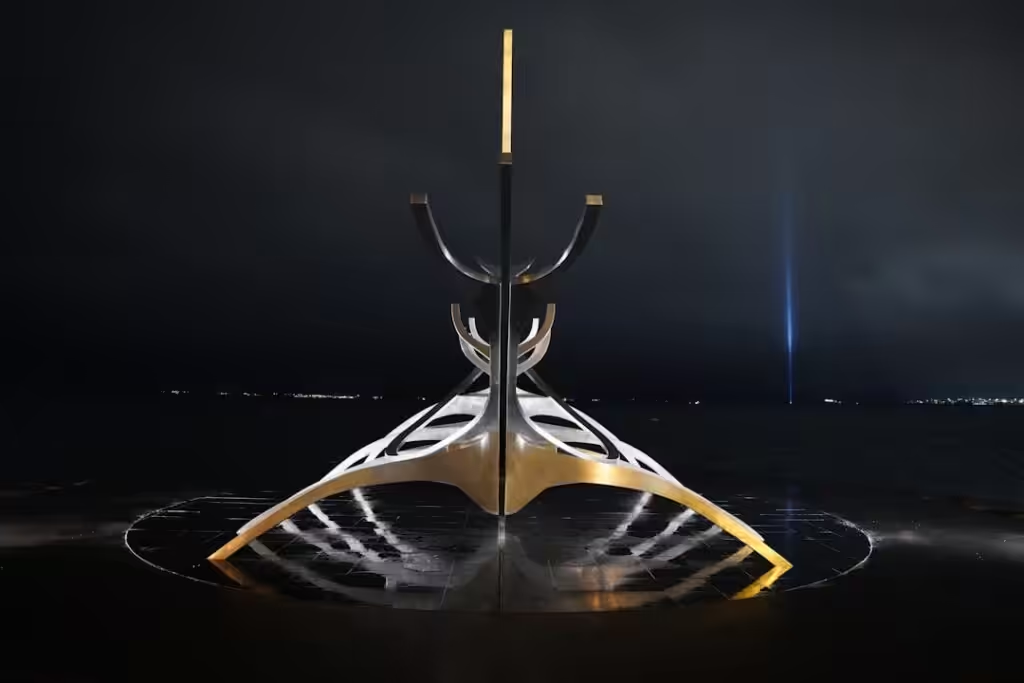
For Iceland, which has competed at Eurovision since 1986, the contest remains a matter of national pride and cultural expression. Whatever shape Eurovision takes in coming years, Iceland’s Söngvakeppnin will keep producing hopeful entries from the North Atlantic — and Icelandic fans will keep watching, whether the competition also features a Canadian act or not.
Frequently asked questions
Is Canada definitely joining Eurovision, or is it still a rumour?
Canada’s participation has been confirmed, with both Icelandic outlet Vísir and Morgunblaðið reporting the news on July 1, 2025, citing the official announcement. This is not speculation — it is a confirmed story backed by multiple credible news sources. The EBU has reached an agreement with Canada’s public broadcaster to allow entry into the contest.
Which Eurovision will Canada compete in first?
Canada is expected to make its Eurovision debut at the 2026 Eurovision Song Contest. The host city for 2026 will be determined by the winner of Eurovision 2025. Canada will likely enter at the semi-final stage in its first year, though a direct Grand Final placement — as was granted to Australia early in its participation — has not been ruled out.
How does a country outside Europe qualify to enter Eurovision?
A country outside Europe can enter Eurovision either through its national public broadcaster holding EBU membership, or through a special invitation extended by the EBU. The EBU’s geographic membership area is broader than the European Union and includes broadcasters from parts of North Africa and the Middle East. Canada’s entry follows one of these two mechanisms, though the exact arrangement has not been fully detailed in early reporting.
Does Iceland support expanding Eurovision to non-European countries?
There is no single official Icelandic position, but public reaction has been broadly curious and cautiously positive. Iceland’s national broadcaster RÚV has not issued a formal statement. Icelandic Eurovision fans tend to welcome anything that raises the contest’s global profile, though some express concern about diluting the competition’s European cultural character.
Where can I follow official updates about Canada at Eurovision 2026?
The most authoritative source for all official Eurovision news, including Canada’s confirmed entry details and the 2026 host city announcement, is the official Eurovision Song Contest website at eurovision.tv. Following the EBU’s own channels and Canada’s public broadcaster announcements will give the earliest confirmed information as the story develops.