A Quick Visit to Petra’s Stone Collection in Stöðvarfjörður
While the Eastfjords of Iceland remain the nation’s most secluded region, their enchanting beauty, quaint fjordside hamlets, and profound tranquility make the lengthy drive worthwhile. On a recent long weekend, I booked a charming Airbnb in Stöðvarfjörður, armed with no agenda other than to follow Route 1 south and see where the journey would take me.
As we set out, the familiar panorama of the south coast greeted my partner and me — Skógafoss stood tall, its persistent rainbow shimmering in the mist, and the landscape unfurled like a vibrant quilt of moss and lupine. A few hours into our road trip, we stopped for coffee at Skool Beans Café, an old American school bus parked just outside Vík. Later, we treated ourselves to hearty veggie hot dogs from a roadside stall by the enchanting Jökulsárlón glacier lagoon. Just past Höfn, a trio of wild geese glided past us in perfect formation, descending onto calm waters like seasoned aviators — their feet lowered like landing gear, painting a picturesque scene.
Not long after, near Djúpivogur, we spotted a herd of reindeer casually ambling along the roadside — a definitive marker that we had indeed arrived in East Iceland.
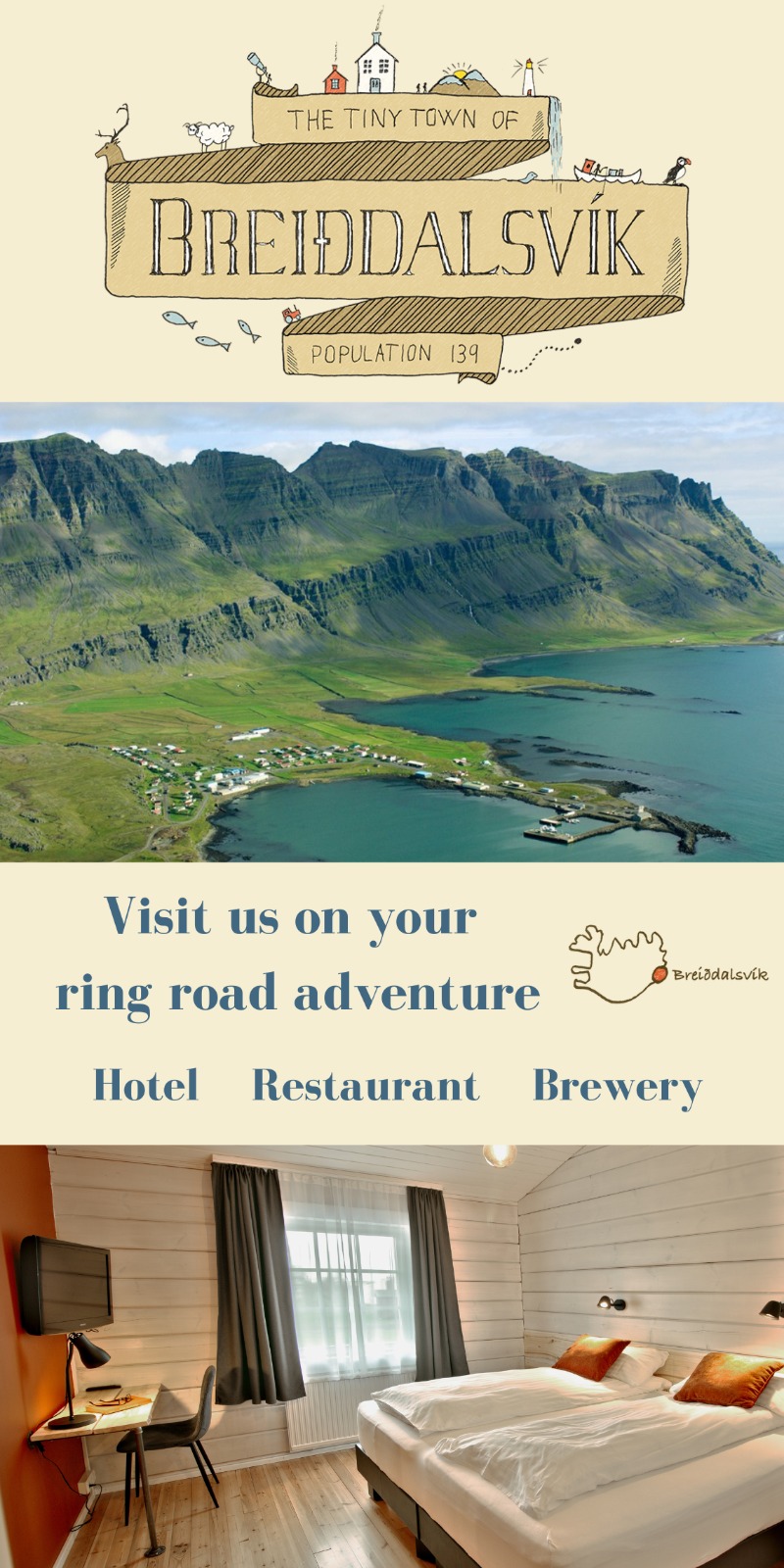
We turned our sights to Djúpivogur, hoping for dinner, but after some exploration, we found ourselves in Breiðdalsvík. Here, the only open option was a local hotel bar, where a sign above the counter read: “Everyone should believe in something. I believe I’ll have another beer.” To be honest, there are worse epitaphs.
After navigating a series of steep turns up a winding road, we finally reached our destination.
The Quirky Side of Stöðvarfjörður
Stöðvarfjörður, a quaint town stretching along the main road, is home to just 182 residents as of 2024. Its charm lies in the scattered houses, a bright blue church, and the dramatic cliffs often shrouded in drifting clouds. On an early June evening, the fields burst with purple wildflowers, and the air felt alive, all under a soft twilight that makes you lose track of time.
“At a time when women were expected to keep the house tidy and bake bread, Petra was out scrambling up hillsides in search of agates.”
This town had long been on my radar for two key reasons. First, the Fish Factory Creative Centre — a repurposed fish processing plant that now pulses with artistic energy, hosting residencies for artists in everything from visual arts to music. Second, Steinasafn Petru (Petra’s Stone Collection), a museum brimming with minerals and crystals gathered over a lifetime by the remarkable Ljósbjörg Petra María Sveinsdóttir. While I’ll save the Fish Factory for another day, this trip, as the town began to stir back to life post-winter, I made it to the latter.
A House Full of Stones
In Iceland, it’s not uncommon to find museums nestled in unexpected locations, but Petra’s collection stands out for its sheer size and the passionate dedication of its founder. Located in Sunnuhlíð, the former home of Ljósbjörg Petra María (1922-2012), the museum spills into the garden, showcasing what her grandson charmingly refers to as a “practically uncountable collection” of stones and minerals. Truth be told, it encompasses thousands of specimens — frequently hailed as one of the largest private stone collections globally.
Notably, Petra’s name translates to “stone” in Greek, a fitting homage to her lifelong passion. Her collecting began in childhood, but it truly flourished once she married and established a home with her husband, where, before that, she often left her finds behind, simply for lack of space.
Before the late 1960s, Stöðvarfjörður had no roads, making travel through the Eastfjords a challenge. Most of Petra’s treasures were gathered from the mountain slopes surrounding her hometown.
Following her husband’s passing in 1974, Petra made a pivotal decision: she opened her home to visitors, welcoming anyone curious to explore her expanding collection. Thus, the museum began to take shape. Even after her death, it remains lovingly maintained by her children and grandchildren.
Wonderfully Wild
Inside, shelves are lined with stones and minerals, showcasing types of quartz in virtually every hue imaginable: lavender haze, turquoise blue, burnt orange, and an entire palette of whites and greys. Some rooms maintain their original charm, adorned with family photographs, embroidered paintings, and memorabilia, including Petra’s Order of the Falcon, awarded to her in 1995 by former President Vigdís Finnbogadóttir.
“Paths twist between wild vegetation, small handmade waterfalls, footbridges, and rows upon rows of stones.”
Accompanying the stones are handwritten notes and occasional photos of Petra herself, often proudly standing next to monumental finds. The collection includes impressively large pieces, leading one to envision Petra, a grandmother in her later years, puzzling over how to transport them home.
Her interests extended beyond rocks; she also amassed a collection of pens, matchboxes, cups, handkerchiefs, and even seashells, all displayed in a dedicated section of the museum. A small café on-site offers soup, pastries, sandwiches, and coffee, all served either in the garden or the sunroom of the house.
While the interior of the museum is curated and organized, I found myself drawn mostly to the garden. In delightful contrast, it feels wonderfully chaotic. Paths weave through wild flora, past charming handmade waterfalls, footbridges, and countless stones. Garden gnomes peek out from behind towering tulips and lush grass. In a corner, Petra’s prized chunk of chalcedony and quartz stands proud; at the center of it all, a life-sized wooden statue of Petra keeps watch. Without the rocks — and admittedly, the slightly eerie realism of that statue — it could easily pass for any elderly Icelander’s garden.
Some might label Petra a hoarder — and undoubtedly, a few did. At a time when women were often relegated to the household, baking bread and keeping things tidy, she was out climbing hills in search of agates. In a town this small, it’s easy to see how that might raise a few eyebrows. Yet, what she left behind transcends mere classification. In this remote fjord, Petra crafted a world filled with purpose and vibrancy. Call it what you will — I’d call it a truly remarkable legacy.
Petra’s Stone Collection is open from May 1 to October 15, daily from 9:00 to 17:00. Admission is 2,000 ISK. More information is available at steinapetra.is