












Iceland’s Hvalur whaling company has logged its tenth fin whale of the 2025 season, a milestone that intensifies scrutiny already building around pollution violations at the company’s processing facility and the ongoing international standoff over Sea Shepherd founder Paul Watson. The tenth catch puts Hvalur roughly one-fifth of the way through its annual quota at a moment when pressure from foreign governments and conservation groups has rarely been higher.
Key takeaways
- Hvalur has taken ten fin whales so far in the 2025 season, out of an annual quota set by Icelandic authorities.
- The tenth whale coincides with an active pollution investigation into Hvalur’s shore station at Hvalfjörður, the fjord north of Reykjavík where carcasses are processed.
- International anti-whaling sentiment is at a peak following the Paul Watson extradition case, giving this season’s catches unusual global visibility.
- Iceland remains one of only three countries — alongside Norway and Japan — that conducts commercial whaling.
- No binding international mechanism currently compels Iceland to halt whaling; pressure is political and economic, not legal.
How Many Whales Has Hvalur Caught So Far This Season?
Hvalur hf., the sole company licensed to hunt fin whales in Iceland, has recorded ten catches in the 2025 season to date. The company operates a small fleet out of Reykjavík’s old harbour and processes animals at its land station in Hvalfjörður — a deep fjord roughly 30 kilometres north of the capital along Route 1. Whaling in Iceland runs through the summer months when fin whales migrate through Icelandic waters, and the fleet typically hunts in the waters off the south and west coasts.
Ten whales at this point in the season is broadly consistent with the pace seen in recent years, though exact daily counts are not published in real time. Observers and conservation organisations tracking vessel movements have reported the tenth catch, and Icelandic media have confirmed it. The season is far from over.
What Does Logging the Tenth Whale Mean for the Quota?
Iceland’s fin whale quota for 2025 was set at 128 animals by the country’s Fisheries Ministry — the same government body, Matvæla-, landbúnaðar- og sjávarútvegráðuneytið, that oversees both fisheries and whaling licences. Ten whales represent roughly 7.8 percent of that quota. At the current pace, Hvalur could approach or reach quota before the season closes in September, though weather, sea conditions, and any regulatory interruption could alter that trajectory significantly.
Fin whales (steiperyrðill in Icelandic) are the second-largest animal on Earth and are listed as Vulnerable on the IUCN Red List. That status is central to why each additional catch generates international headlines well beyond Iceland’s borders.
How Does This Connect to the Ongoing Pollution Investigation?
The tenth whale arrives against the backdrop of a live environmental investigation. Icelandic authorities have been examining pollution discharge from Hvalur’s processing station at Hvalfjörður, where blood, offal, and processing wastewater enter the fjord. Reports from Icelandic environmental agency Umhverfisstofnun indicate that inspections found discharge levels exceeding permitted limits at the facility.
Hvalfjörður is not only an industrial site — it is a popular destination for Icelanders and travellers who drive the scenic fjord road rather than the tunnel shortcut under the water. Whale watching boats operate nearby. The visual and symbolic collision between industrial whaling waste and a tourist-friendly landscape has amplified domestic criticism in a way that purely abstract quota arguments do not.
The pollution case has not resulted in a suspension of operations as of the time of writing. However, it gives environmental regulators a separate, domestic legal lever that international pressure does not provide. If violations are confirmed at the level required by Icelandic law, fines or operational conditions could follow — though a full shutdown of the season based on pollution findings alone would be legally complex.
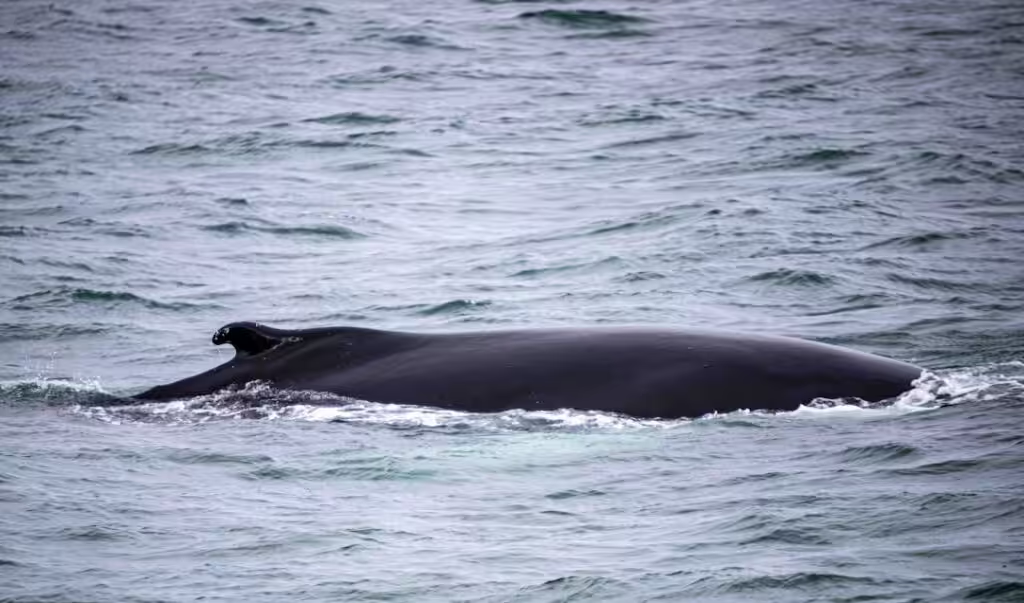
What Is the International Reaction to Iceland’s 2025 Whaling Season?
International reaction has been sharper than in most recent years, driven in large part by the Paul Watson case. Watson, the founder of Sea Shepherd and a figurehead of global anti-whaling activism, was arrested in Greenland in 2024 on a Japanese warrant and faced extradition proceedings that kept the issue of commercial whaling in global headlines for months. Although Watson was ultimately released, the case embedded Iceland’s whaling season into a much larger international narrative.
Conservation organisations including the International Fund for Animal Welfare (IFAW) and Whale and Dolphin Conservation (WDC) have each issued statements calling on Iceland to end commercial whaling. The European Parliament has previously passed non-binding resolutions opposing the practice. Several US lawmakers have cited Iceland’s whaling record in discussions about trade preferences.
Social media amplification has also changed the character of the reaction. Each confirmed catch now generates immediate coverage across environmental networks, reaching audiences who had little awareness of Icelandic whaling in previous years. The tenth whale, in particular, has circulated widely as a symbolic count.
Is Iceland Under Pressure to Stop Whaling This Year?
Yes — but the pressure remains political rather than legally binding. Iceland is not a member of the International Whaling Commission’s (IWC) commercial whaling moratorium in practice; it rejoined the IWC in 2002 with a formal objection to the moratorium, giving it the legal standing to set its own quota under domestic law. No international body currently has the authority to order Iceland to stop.
The pressure points are instead economic and diplomatic:
- Trade: The United States has previously threatened and applied trade sanctions under the Pelly Amendment, which allows presidential action against countries that undermine international fisheries or wildlife agreements. Whether the current US administration would activate that mechanism is uncertain.
- Tourism reputation: Iceland’s international image as a nature destination is a genuine commercial concern. Tour operators and tourism boards are acutely aware that whaling controversy affects how Iceland is perceived in key source markets, particularly the United States, Germany, and the United Kingdom.
- Domestic politics: Sentiment inside Iceland is more divided than international coverage suggests. Polling in recent years has shown decreasing support for whaling among younger Icelanders, and some Alþingi — Iceland’s parliament — members have called for a review of the quota system. However, no vote to end whaling has passed, and the current government has not signalled a policy reversal.
- Export markets: Fin whale meat is exported primarily to Japan. If that market contracted or import restrictions tightened, the economic case for whaling would weaken substantially — arguably more so than any diplomatic statement.
For now, Hvalur continues to operate within Icelandic law. The combination of the pollution investigation, the tenth catch milestone, and sustained international attention makes the 2025 season the most scrutinised in several years.
What Travellers to Iceland Should Know
For visitors planning trips to Iceland this summer, the whaling controversy is unlikely to affect travel logistics directly. Hvalfjörður, where the processing plant operates, is accessible by road and remains a scenic detour off the Ring Road — but travellers sensitive to the issue should be aware of the site’s industrial use. The fjord road itself, which loops around rather than tunnelling under the water, passes within sight of the Hvalur facility.
Whale watching remains widely available from Reykjavík’s old harbour (Ægisgarður pier) and from Húsavík in the north, which markets itself as the whale-watching capital of Europe. Operators in both locations emphasise non-lethal tourism and have long positioned themselves as an economic alternative to hunting. Booking with operators certified by the Icelandic Tourist Board ensures a baseline of regulatory compliance.
For the latest official updates on Iceland’s whaling quota and environmental investigations, the Icelandic Environment Agency (Umhverfisstofnun) publishes relevant decisions at ust.is.
Frequently asked questions
Is commercial whaling legal in Iceland in 2025?
Yes. Iceland conducts commercial whaling under its own domestic legislation and holds a formal objection to the International Whaling Commission’s moratorium, which means the moratorium does not legally apply to Iceland. The government issues annual quotas through the Fisheries Ministry. In 2025, the fin whale quota stands at 128 animals.
Who owns Hvalur and who is behind Iceland’s whaling operations?
Hvalur hf. is a privately owned Icelandic company and the only entity currently licensed to hunt fin whales in Iceland. It is the dominant commercial whaling operator in the country. The company owns the processing station at Hvalfjörður and operates the vessels that hunt in Icelandic waters during the summer season.
What is the pollution investigation into Hvalur about?
Iceland’s environmental regulator, Umhverfisstofnun, has been investigating whether Hvalur’s processing facility at Hvalfjörður has discharged blood, offal, and wastewater into the fjord in excess of permitted levels. The investigation is ongoing. A confirmed violation could result in fines or operational conditions, though a full suspension of the whaling season on this basis alone would require a separate legal process.
How does the Paul Watson case relate to Iceland’s whaling?
Paul Watson, founder of Sea Shepherd, was arrested in Greenland in 2024 on a warrant issued by Japan related to his anti-whaling activism. His detention and subsequent release kept commercial whaling — practised by Iceland, Norway, and Japan — in global headlines far longer than a single season’s catch typically would. The case drew renewed international attention to all three whaling nations, including Iceland’s 2025 season.
Can tourists go whale watching in Iceland despite the whaling controversy?
Yes. Whale watching operates entirely separately from commercial whaling and is one of Iceland’s most popular tourism activities. Reykjavík and Húsavík are the main departure points, with tours running from April through October. Most operators are explicitly opposed to hunting and promote whale watching as a sustainable alternative. Booking through operators registered with the Icelandic Tourist Board is recommended.