












Iceland’s glaciers are shrinking at an accelerating pace, according to fresh data released in mid-2026. New measurements confirm that Iceland’s ice coverage has continued its decades-long decline, with several major glaciers recording some of their sharpest annual losses yet — raising urgent questions about the country’s landscape, water systems, and tourism future.
Key takeaways
- New 2026 data confirms Iceland’s glaciers are still retreating, with no sign of the trend reversing.
- Smaller glaciers such as Snæfellsjökull and Þórufell are among the fastest-retreating ice masses.
- Rising North Atlantic temperatures and reduced winter snowfall are the primary drivers.
- Scientists warn Iceland’s smaller glaciers could disappear within decades; Vatnajökull, the largest, faces severe long-term loss.
- Glacier tourism remains viable now but visitors should expect visibly changed landscapes compared to even five years ago.
How Much Have Iceland’s Glaciers Shrunk in 2026?
Iceland’s glaciers collectively cover roughly 11 percent of the country’s land area — but that figure is falling every year. While the full 2026 annual audit is still being compiled by Icelandic glaciologists, data released so far indicates continued net mass loss across all major ice caps. Iceland has lost approximately 50 to 60 square kilometres of glacier coverage per year on average over the past decade, and preliminary 2026 figures are consistent with that trend, according to researchers tracking the country’s ice.
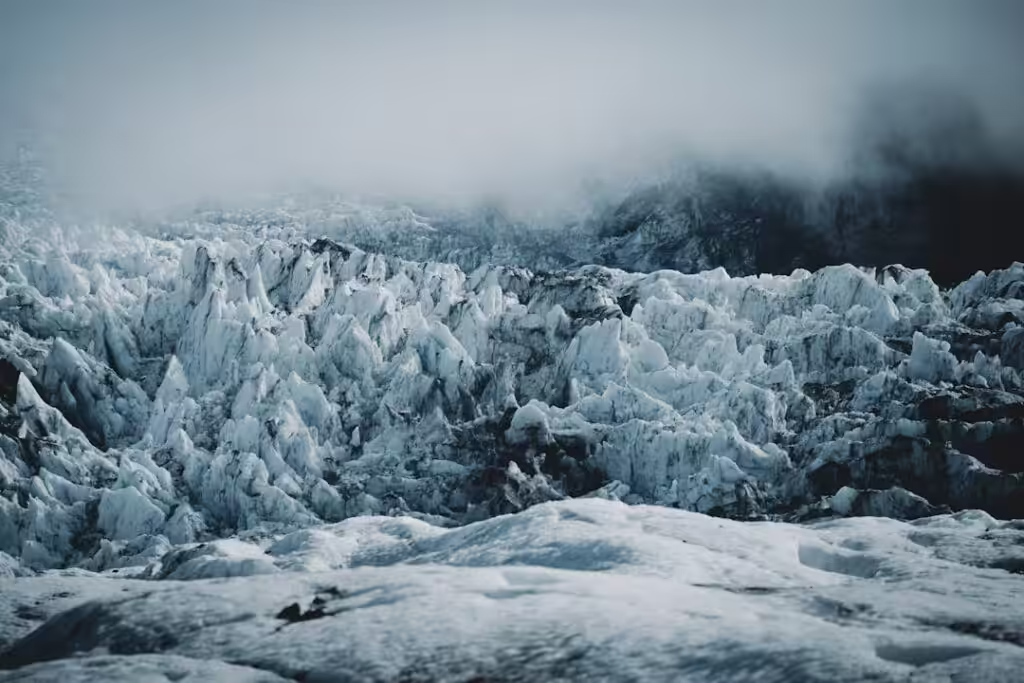
The Icelandic Meteorological Office — Veðurstofa Íslands — monitors glacier mass balance annually in partnership with university researchers. Their measurements use a combination of GPS stakes drilled into the ice, satellite imagery, and aerial surveys. So far in 2026, readings from multiple sites point to another year of negative mass balance, meaning the glaciers lost more ice through melting than they gained through snowfall. Veðurstofa Íslands publishes ongoing glacier data on its official website.
Since formal records began in the 1990s, Iceland’s glaciers have collectively lost an estimated 2,000 square kilometres or more of surface area. That is a loss roughly equivalent to the surface area of the entire Westfjords peninsula — a comparison that puts the scale of the change into stark relief.
Which Icelandic Glaciers Are Retreating Fastest?
Not all glaciers are disappearing at the same speed. Smaller, lower-altitude ice masses are retreating the fastest, because they lack the sheer mass to buffer warm summers.
- Snæfellsjökull — the glacier-capped volcano on the Snæfellsnes peninsula, made famous by Jules Verne, has lost a significant portion of its ice over recent decades and continues to recede each summer season.
- Drangajökull — the northernmost glacier in Iceland, located in the Westfjords, is often cited as one of the more vulnerable ice caps due to its relatively low elevation.
- Langjökull — Iceland’s second-largest glacier, in the central highlands, has seen dramatic thinning along its southern margins. Ice tunnel tours there now pass through features that were far deeper under the surface when the tunnels were first engineered.
- Mýrdalsjökull — the ice cap above the Katla volcano system in the south has shown consistent annual retreat at its outlet glaciers, including Sólheimajökull, which is one of the most-visited and most-photographed receding glaciers in the country.
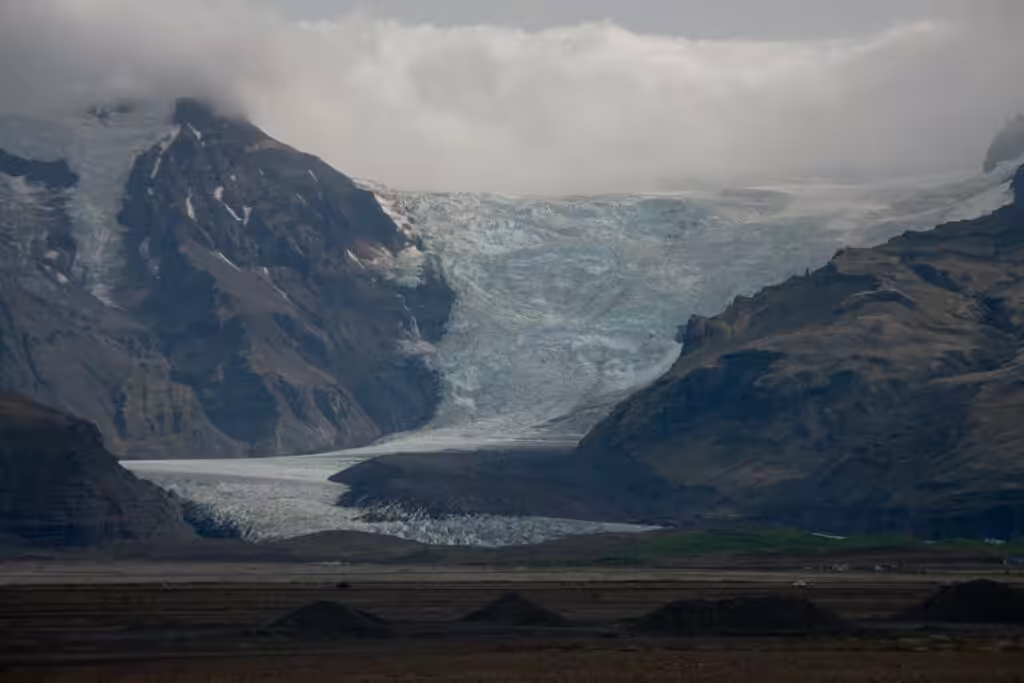
- Vatnajökull — Europe’s largest glacier by volume, spanning roughly 8,000 square kilometres in southeast Iceland, is retreating at its outlet glaciers even though its sheer size means it will outlast the smaller ice caps by centuries.
Sólheimajökull, the accessible outlet glacier off the Katla ice cap near the Ring Road, has retreated by well over a kilometre since the early 2000s. Guides leading glacier walks there say new black rock faces are visible each season that were buried under ice only a few years ago. That firsthand change is visible to any visitor who has walked the glacier more than once.
What Is Causing Iceland’s Glaciers to Keep Melting?
The primary cause is rising temperatures driven by climate change. Iceland sits at the edge of the North Atlantic, where ocean and atmospheric warming are both measurable and intensifying. Mean annual temperatures in Iceland have risen by roughly 1.5 to 2 degrees Celsius over the past century, with the sharpest increases recorded in recent decades.
Several factors compound the problem:
- Warmer summers extend the melt season, eating into the ice for longer each year before autumn snowfall can begin to replenish it.
- Reduced winter snowfall at lower elevations means some glaciers receive less annual accumulation than they need to offset summer losses.
- Ocean heat from the warming North Atlantic affects coastal ice margins and contributes to faster calving at glacier termini that reach the sea.
- Ice-albedo feedback — as glaciers lose their bright white surface and expose darker rock or dirty ice, they absorb more solar radiation and melt faster still.
- Volcanic heat plays a localised role beneath ice caps such as Vatnajökull and Mýrdalsjökull, but scientists are clear that volcanic activity is not the main driver of the broader trend. Climate change is.
Iceland’s own carbon emissions are relatively low — the country runs almost entirely on geothermal and hydroelectric power — but it sits in a global climate system where emissions from elsewhere drive the warming that is melting its ice.
Will Iceland’s Glaciers Disappear Entirely — and When?
The honest scientific answer is: some already have, and more will follow within this century. Iceland’s first glacier officially declared dead was Okjökull — known as Ok — in 2019, when it no longer moved as ice and was reclassified as a dead ice patch. A memorial plaque was installed on the mountain, addressing future generations with what has become an iconic piece of climate text.
Projections vary by glacier size and elevation. Researchers have estimated that under current warming trajectories, Iceland could lose most of its smaller glaciers by 2100. Some models suggest that by 2200, even Vatnajökull could be reduced to a fraction of its current size if global emissions continue on a high pathway. Under lower-emission scenarios, the pace slows — but does not stop.
Snæfellsjökull is among those most at risk within this century. Scientists have discussed the possibility of it disappearing entirely before 2050 under worst-case warming, though projections carry significant uncertainty. What is not uncertain is the direction of travel.
What Does Glacier Loss Mean for Iceland’s Landscape and Tourism?
Glacier retreat is reshaping Iceland in ways that go well beyond aesthetics. The practical consequences are wide-ranging:
- Rivers and water supply — many of Iceland’s rivers are glacially fed. As glaciers thin, rivers will initially run higher as meltwater increases, then drop as the ice reserve is depleted. Long-term, some river systems will shrink dramatically.
- Isostatic rebound — as ice mass is removed, the land beneath rises. Iceland is already rising measurably each year in glacier regions, which affects geothermal systems and could, over very long timescales, alter volcanic activity patterns.
- Glacial lake floods — known in Icelandic as jökulhlaup, these sudden meltwater outbursts from subglacial lakes become more frequent as ice thins. The area around Vatnajökull and the Skeiðarársandur outwash plain has seen multiple such floods in recent decades.
- Tourism — glacier hiking, ice cave tours, and snowmobile excursions are among Iceland’s most popular activities and a significant part of its economy. Tour operators in areas like Skaftafell and on Langjökull report having to move access points, recut trails, and retire tours as specific ice features disappear.
For travellers, the message is straightforward: if seeing Iceland’s glaciers is on your list, go sooner rather than later. Sólheimajökull, accessible directly from the Ring Road about 160 kilometres east of Reykjavík, remains one of the most dramatic and reachable places to see glacier retreat up close. Certified glacier guides operate from the car park year-round; a standard two to three hour guided walk currently costs in the region of 10,000 to 15,000 ISK per person depending on the operator and season.
The ice caves beneath Vatnajökull, accessed through tours departing from the town of Höfn or operators based near Jökulsárlón glacial lagoon, are another iconic experience — but the natural blue-ice caves that form each winter depend on the glacier staying cold enough, for long enough, each autumn. Operators say the window for safe cave access has been shortening.
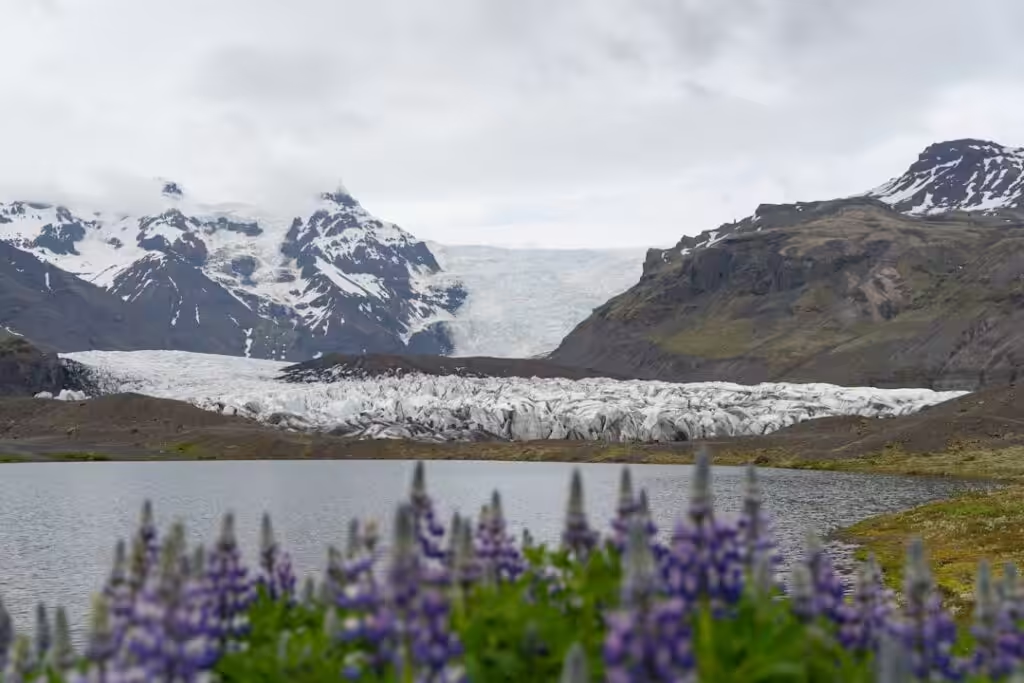
Jökulsárlón itself — the famous iceberg lagoon on the south coast — is paradoxically growing larger as Breiðamerkurjökull, the glacier that feeds it, retreats inland. The lagoon is now among the deepest lakes in Iceland. But the icebergs floating in it are, in a sense, a monument to disappearing ice.
Frequently asked questions
Is it still worth visiting Iceland’s glaciers in 2026?
Yes — Iceland’s major glaciers, including Vatnajökull, Langjökull, and Mýrdalsjökull, remain substantial and accessible. Guided glacier walks, snowmobile tours, and ice cave excursions are still operating. However, landscapes are visibly changing year on year, and some specific tours or ice features have been retired as ice retreats. Book with a certified local guide for safety and up-to-date access information.
Which Icelandic glacier is easiest to visit?
Sólheimajökull, an outlet glacier of Mýrdalsjökull on the south coast, is the most accessible for independent travellers. It sits about 160 kilometres east of Reykjavík on the Ring Road, with a signposted car park and certified guided walks operating daily. It is also one of the most visibly retreating glaciers in Iceland, making it a powerful first-hand illustration of climate change.
What was Okjökull and why does it matter?
Okjökull — commonly called Ok — was a glacier in western Iceland that was officially declared dead in 2019 after losing enough mass that it no longer moved as active ice. A commemorative plaque was installed on the mountain, addressed to future generations. It became a globally recognised symbol of glacier loss and was the first Icelandic glacier to receive an official death notice. Researchers expect more glaciers to follow.
How fast is Vatnajökull retreating?
Vatnajökull, Europe’s largest glacier by volume and a UNESCO World Heritage Site, is losing mass at its outlet glaciers each year. Its outlet Breiðamerkurjökull has retreated several kilometres over recent decades, directly causing the growth of Jökulsárlón glacial lagoon. While Vatnajökull’s total volume means it will persist far longer than Iceland’s smaller glaciers, scientists project significant long-term reduction under current climate trajectories.
Where can I find official updates on Iceland’s glacier data?
The Icelandic Meteorological Office, Veðurstofa Íslands, publishes glacier monitoring data including mass balance measurements and area surveys at vedur.is. The University of Iceland’s Institute of Earth Sciences also conducts ongoing glacier research. For travellers, local glacier tour operators near Skaftafell, Jökulsárlón, and on the Snæfellsnes peninsula are the most current source of practical access conditions.