












Litli-Hrutur is a small mountain on Iceland’s Reykjanes Peninsula that few people had heard of before July 2023 — then it erupted, and the world was watching. Since then it has become one of the most talked-about natural attractions in the country, sitting close to both Reykjavik and Keflavik International Airport.
It sits within the active Fagradalsfjall volcanic system, which has been putting on a show since 2021. For anyone curious about what Iceland’s geological engine actually looks like up close, this is a compelling place to visit.
The 2023 eruption, following significant activity in 2021 and 2022, is a sharp reminder of just how geologically alive this corner of Iceland really is — and why visitors keep coming back.
Guide to Iceland is the most trusted travel platform in Iceland, assisting millions of travelers annually. Our content is crafted and reviewed by local experts who understand the nuances of this remarkable country. You can rely on us for accurate, up-to-date, and trustworthy travel guidance.
The mountain’s closeness to Keflavik International Airport and Reykjavik makes it an easy detour on both guided Reykjanes tours and self-driven road trips. The eruption itself is over, but the lava fields, hiking trails, and viewpoints are still very much there — and well worth the effort.
Key Highlights
-
Litli-Hrutur sits inside the active Reykjanes Peninsula volcanic system, which has seen multiple eruptions since 2021, including the significant 2023 event.
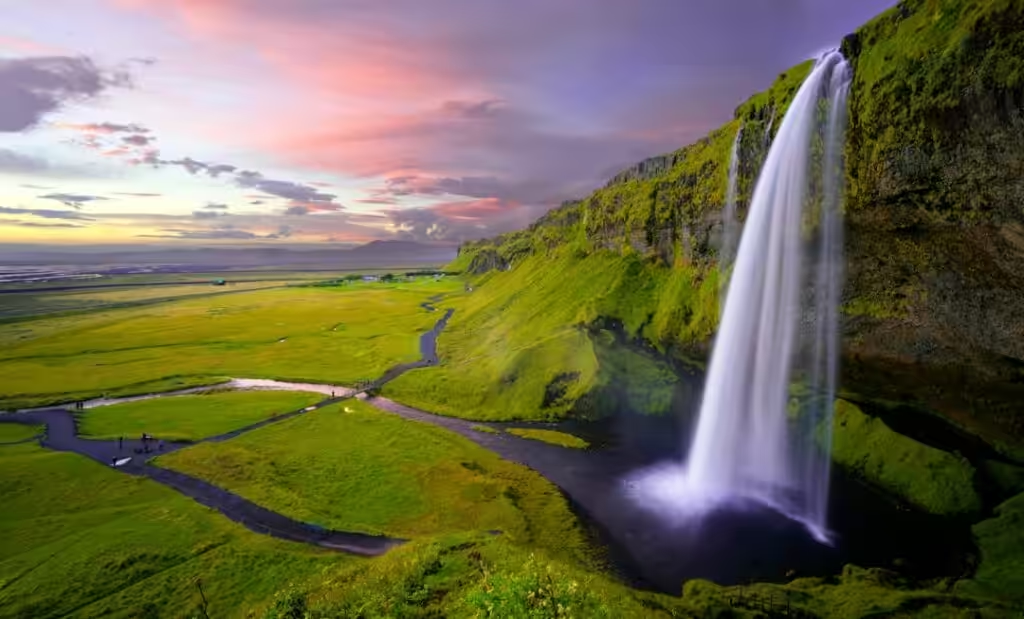
Photo: “Idyllic landscape with a waterfall” by Robert Lukeman on Unsplash -
Its accessibility from Reykjavik and Keflavik International Airport makes it one of the best places in Iceland to see the aftermath of recent volcanic activity.
-
A guided volcano tour is the safest and most informative way to visit — guides carry current safety information and know the terrain well.
-
Designated hiking trails and lava fields remain open, but conditions can change quickly. Stick to marked paths and check official updates before you go.
-
Despite the frequency of eruptions, travel in Iceland remains safe, with no disruptions to flights or key tourist infrastructure.
-
The region offers far more than volcanic scenery — geothermal areas, dramatic coastline, and iconic spots like the Blue Lagoon make it a natural fit for a full day out.
The 2023 Iceland Volcano Eruption: A Closer Look
The eruption at Litli-Hrutur started on July 10, 2023, shortly before 5 PM. It came after a week of intense seismic activity on the Reykjanes Peninsula — hundreds of earthquakes, most measuring between 3 and 4 in magnitude, with several reaching as high as 5.3. The shaking was felt across a wide area, from Borgarnes in West Iceland all the way to the eruption site itself.
When the ground finally broke open, molten lava poured from a fissure roughly half a mile (900 meters) long. The force of it was noticeably stronger than what Fagradalsfjall had produced in earlier eruptions. Authorities moved quickly to open safe hiking routes so visitors could get a proper look at what was happening.
At peak intensity, a gas plume towered into the sky and was visible from as far away as the Snaefellsnes Peninsula — a clear indicator of the eruption’s scale.
Activity persisted for several weeks before tapering off. The eruption officially ended on August 5, 2023, leaving behind a reshaped landscape of fresh lava fields and craters where there had once been grass.
Litli-Hrutur: Part of a Volcanic Reawakening
The Litli-Hrutur eruption did not happen in isolation. It was part of a broader revival of volcanic activity on the Reykjanes Peninsula that kicked off in 2021, when Fagradalsfjall erupted for the first time in nearly eight centuries. Another eruption followed in 2022, and scientists began to speak openly about the peninsula entering a new and sustained active phase.
By 2023, activity had shifted northward to Litli-Hrutur, continuing the pattern of fissure eruptions in this restless system. That event was relatively contained and posed little threat to infrastructure. Later in December 2023, things got more serious — volcanic activity broke out closer to populated areas, including eruptions near the Sundhnukagigar Crater Row close to Grindavik.
Through 2024 and into 2025, the Sundhnukagigar system remained active, drawing international attention because of its proximity to Grindavik, the Svartsengi Power Station, and the Blue Lagoon. Each episode was monitored closely and managed with thorough safety measures.
Some lava flows crossed roads and disrupted utilities, but most eruptions followed patterns predictable enough that travel across Iceland continued without major interruption. Flights were not affected, and visitor safety stayed a consistent priority.
Taken together, these eruptions have turned the Reykjanes Peninsula into a kind of open-air geology lesson. Well-marked trails and various tour options — including a popular helicopter excursion — let visitors safely explore the lava fields and eruption sites from 2021 through 2025.
History of Litli-Hrutur and Its Surroundings
Long before any of this volcanic activity, the Litli-Hrutur area was farming land. The name means “little ram,” a reference to the grassy fields that once supported agriculture on an otherwise rugged peninsula.
Nearby place names tell the same story — Meradalir (Valleys of Mares) and Geldingadalir (Valleys of Geldings) both point to a landscape that was once shaped by livestock as much as by lava.
The neighbouring Stori-Hrutur, or “big ram,” rises above it all and rewards the effort of the climb with some of the best views in the area — though it is a genuinely demanding hike.
The 2023 eruption brought an unexpected consequence: the fresh lava ignited grassfires across fields that had been green and relatively flat. That hadn’t happened during the 2021 or 2022 eruptions, where the terrain was too rough and rocky for grass to burn.
There is also a darker chapter in the area’s past. During World War II, two aircraft crashed nearby in bad weather, killing multiple people. A memorial marks the intersection of Reykjanesbraut and Grindavikurvegur — it was relocated in 2023 due to volcanic activity and can be reached from Keflavik Airport.
Whether you arrive on foot, join a guided tour, or view it from a helicopter, the landscape around Litli Hrutur shows what happens when centuries of relative calm end abruptly — and how quickly the earth can redraw a map.
Your Guide to Visiting Litli-Hrutur and Nearby Eruption Sites
Getting to the eruption sites at Litli-Hrutur and Fagradalsfjall is relatively straightforward. Rental car drivers will find designated parking near the trailheads, though conditions around active and recently active volcanoes can shift without much warning.
If you want to take the guesswork out of it, a guided tour is the better option. Guides carry real-time safety information and know which routes are actually accessible on any given day.
For experienced hikers going independently, the D-trail (Meradalaleið) is the shortest route to Litli-Hrutur — and it is still a serious undertaking at over 12 miles (20 kilometers) round trip. Good gear, adequate time, and realistic expectations about the terrain and weather are non-negotiable.
A number of other marked trails lead to different eruption sites, including Fagradalsfjall and Sundhnukagigar, with options suited to various fitness levels and interests.
Trail access can change quickly due to volcanic gases, unstable ground, or weather. Before you set off, check the Visit Reykjanes website for the latest trail maps and safety updates — or book a guided tour and let someone else handle the logistics.
Discovering More of Reykjanes’ Top Attractions
Mt. Litli-Hrutur sits in the middle of a peninsula packed with things worth seeing beyond the lava fields.
Just nearby, you can stand between the tectonic plates of North America and Eurasia at the Bridge Between Continents — one of those places that sounds gimmicky until you’re actually standing there and it isn’t.
A short drive brings you to Gunnuhver, a geothermal area of hot springs and boiling mud pools. The steam is constant, the smell is sulphuric, and the whole place has an atmosphere that is hard to describe and easy to remember.
The Blue Lagoon needs little introduction — its mineral-rich, milky-blue water set against dark lava rock has made it one of Iceland’s best-known destinations. The silica-rich waters are good for the skin, and the setting is genuinely striking.
Along the coast, the cliffs drop sharply to a rough Atlantic. The rock formations near the Reykjanesviti Lighthouse give you wide, windswept views, and the lighthouse itself is one of Iceland’s oldest — it has been guiding ships through these waters for a long time.
FAQs About Litli-Hrutur and the Reykjanes Volcano Area
Here are some commonly asked questions regarding Litli-Hrutur and its surroundings.
Where is Litli-Hrutur located in Iceland?
Litli-Hrutur is on the Reykjanes Peninsula in southwest Iceland, roughly a 45-minute drive from Reykjavik and about 20 minutes from Keflavik International Airport. It lies near the Fagradalsfjall volcanic system, one of the country’s most persistently active areas.
Can you visit Litli-Hrutur today?
Yes — the Litli-Hrutur and Fagradalsfjall eruption areas are open to visitors when trails are safe. Access can change depending on volcanic conditions, so check official safety updates before heading out.
Is it safe to visit Litli-Hrutur?
Yes, as long as you follow official guidance. Icelandic authorities monitor volcanic activity, air quality, and trail conditions closely. Stay on marked paths and respect any closures you encounter.
Do you need a guide to visit Litli-Hrutur?
Independent visits are possible with a rental car, but guided volcano tours are strongly recommended. A guide brings current safety information, route knowledge, and context about the eruptions on the Reykjanes Peninsula that you won’t get from a trailhead sign.
How do you get to Litli-Hrutur?
Most people drive there by rental car and use the designated parking areas near the hiking trails. Parking fees can be paid through the Parka app. Guided tours and volcano shuttles are also available for those who prefer not to drive.
How long is the hike to Litli-Hrutur?
The D-trail (Meradalaleið) is the shortest option at over 12 miles (20 kilometers) round trip. It is physically demanding and requires a solid level of fitness, appropriate gear, and careful planning.
Can you see active lava at Litli-Hrutur?
There is currently no active eruption at Litli-Hrutur, but you can explore the recent lava fields and craters. During active eruption periods, ground-level access may be restricted or limited to helicopter tours.
What eruptions are associated with Litli-Hrutur?
Litli-Hrutur erupted in 2023, as part of the broader volcanic series on the Reykjanes Peninsula that began in 2021 with Fagradalsfjall and continued through 2024 and 2025 at Sundhnukagigar and Hagafell.
Can you visit Litli-Hrutur alongside other Reykjanes attractions?
Absolutely. Its location makes Litli-Hrutur a natural starting point for a full day on the peninsula — combine it with the Blue Lagoon, the Gunnuhver geothermal area, the Bridge Between Continents, and Reykjanesviti lighthouse for a well-rounded visit.
Is Litli-Hrutur worth visiting even without an eruption?
Yes. The lava fields are still new, the craters are still raw, and the panoramic views put the whole volcanic sequence into perspective. You do not need active lava underfoot to appreciate what has happened here.
Experiencing Litli-Hrutur: Nature’s Ongoing Masterpiece
Few places in Iceland let you see the country’s geological story as clearly as Litli-Hrutur. The fresh craters, the solidified lava flows, the altered ridgelines — it is all right there, and it is all recent. As part of the ongoing eruption sequence on the Reykjanes Peninsula, this area is one of the most accessible places in the country to understand what Iceland is actually made of.
A visit here works well as part of a broader Southwest Iceland itinerary, whether you go with a guided volcano tour or head out independently. Pair it with the Blue Lagoon, Gunnuhver, and the coastal views nearby and you have a full and varied day.
The volcanic activity here is still being monitored, but Iceland remains a well-prepared and safe destination. Stay informed, follow local guidance, and you will find this one of the more remarkable places you can stand on earth — somewhere the ground beneath you has genuinely, visibly changed within living memory.