Most Icelanders speak excellent English, and you will not struggle to order coffee, ask for directions, or book a tour. But here’s the thing — when you try even a few Icelandic language phrases, something shifts. People light up. A stranger at a petrol station in Vík will smile properly, not just politely. The country opens up a little differently when you’ve made the effort, however small.
Icelandic is one of the oldest languages in Europe, and it has changed remarkably little since the settlers arrived in the 9th century. A modern Icelander can read the medieval sagas the way you might read a slightly old-fashioned newspaper. That linguistic continuity is something the country takes seriously — there’s a whole government committee whose job is coining new Icelandic words rather than borrowing from English. So when you try to speak it, you’re not just being polite. You’re acknowledging something they genuinely care about.
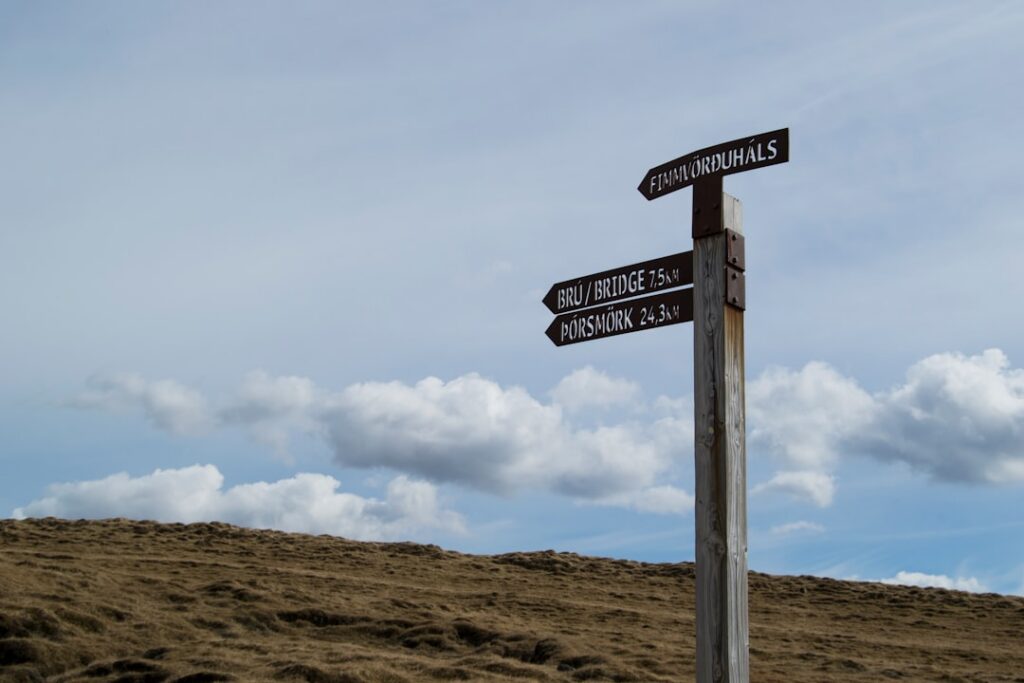
This isn’t a comprehensive language course. It’s what actually helps on a trip, from landing at Keflavík to your last night in Reykjavík, delivered without the phonetic overcomplications that usually make traveller phrase guides useless.
Icelandic Language Phrases You’ll Use on Day One
Let’s start with the basics — the words that come up before you’ve even had your first Skyr.
Greetings and politeness
Halló (ha-loh) — Hello. Simple, borrowed from English, and everyone uses it.
Góðan dag (goh-than dahg) — Good day. More formal, but genuinely appreciated if you’re walking into a guesthouse or a sit-down restaurant. The ð (called an eth) sounds like the soft ‘th’ in ‘the’, not the hard one in ‘think’.
Bless (bless) — Goodbye. Yes, it sounds like the English word, and yes, Icelanders say it constantly. You’ll hear it at the end of every phone call and as you leave every shop. Once you start using it, it’s hard to stop.
Takk (tahk) — Thank you. Short, easy, non-negotiable. Use it freely.
Takk fyrir (tahk fear-ir) — Thank you for… Used at the end of a meal, after someone has helped you, or when leaving someone’s home. The extra syllables go a long way.
Fyrirgefðu (fear-ir-gev-thuh) — Excuse me / Sorry. This is a useful one because it covers both getting someone’s attention and apologising when you bump into them in a narrow café doorway. It sounds complicated but breaks into rhythmic chunks once you practise it twice.
Yes, no, and the useful in-betweens
Já (yow, rhyming with ‘cow’) — Yes.
Nei (nay) — No.
Kannski (kahn-skee) — Maybe. You’ll need this when someone asks if you’re planning to drive the Snæfellsnes Peninsula in one day.
Ég skil ekki (yehg skil eck-ee) — I don’t understand. More honest and more useful than smiling blankly.
Talarðu ensku? (tah-lar-thuh en-skuh?) — Do you speak English? Asking this in Icelandic first is the move. Almost always the answer is yes, and you’ve already made a good impression.
Ordering Food and Drinks Without Pointing at the Menu
Food vocabulary is where practical phrases really earn their keep. Menus in Reykjavík restaurants often come in English too, but smaller towns — Hólmavík in the Westfjords, Höfn in the East — may not always have full translations. Knowing a few food-related words is genuinely handy.
Matseðillinn, takk (mat-seth-ilin, tahk) — The menu, please.
Ég ætla að fá… (yehg ight-la ath fow) — I’ll have… Followed by whatever you’re ordering. You can point at something and still use this opener — it sounds much better than just pointing in silence.
Hvað mælirðu með? (kvath my-lir-thuh meth?) — What do you recommend? Icelanders love recommending things, and the person serving you almost certainly has an opinion about whether the lamb soup or the fish of the day is better today.
Án glútens (own gloo-tens) — Without gluten. Dietary requirements in Icelandic are increasingly well-catered for, especially in Reykjavík, but knowing how to say gluten-free helps outside the capital.
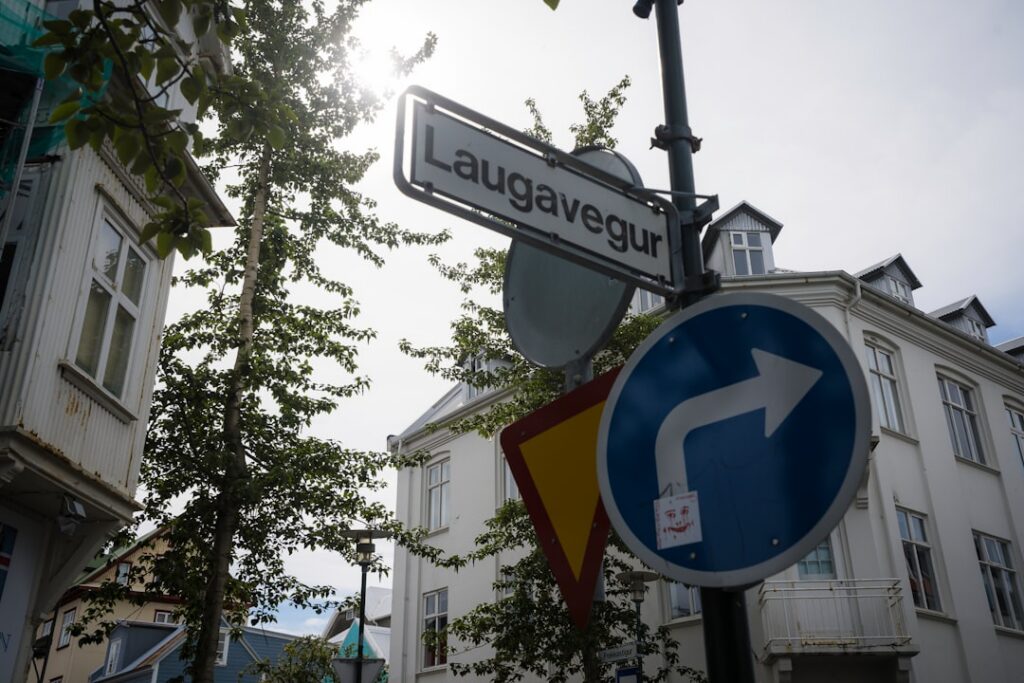
Rjómi (ryoh-mee) — Cream. Mjólk (myolk) — Milk. Useful in the kind of bakery where the staff are busy and the coffee situation requires quick clarification. Sandholt on Laugavegur and Brauð & Co on Frakkastígur both get packed in the morning — knowing your dairy vocabulary speeds things up.
Reikninginn, takk (rake-nin-in, tahk) — The bill, please. One of the most important phrases of any trip.
Getting Around: Directions and Transport Words
Driving is how most visitors see Iceland properly — the Ring Road, the Golden Circle route, down to Jökulsárlón, across to Landmannalaugar. Even with GPS, you’ll occasionally have a human conversation about roads and distances, and place names are half the battle.
The direction basics
Hvar er…? (kvar air) — Where is…? The most important question structure you can learn. Plug in any place name after it.
Hægri (high-gree) — Right. Vinstri (vin-stree) — Left. Beint áfram (baynt owv-ram) — Straight ahead.
Langt? (langt?) — Far? Paired with a point in a direction, you’ll get a useful answer.
Vegurinn er lokaður (veh-gur-in air loh-kath-ur) — The road is closed. You may see this on signs in winter, or hear it on the radio. Knowing what it means matters — Icelandic road closures are not suggestions.
Place name pronunciation — the confidence gap
The biggest barrier most travellers face isn’t vocabulary. It’s the place names. They look intimidating on the page, but most follow consistent rules once you learn a handful of them.
Þ (thorn) is always ‘th’ as in ‘think’ — so Þingvellir is Thin-gvet-lir, and Þórsmörk is Thor-smork. The volcanic crater lake Öskjuvatn is usk-yuh-vatn. Eyjafjallajökull — the volcano that closed European airspace in 2010 — is ay-ya-fyat-la-yuh-kootl. Once you hear a local say it, it makes complete sense.
Trying to say place names correctly, even imperfectly, is appreciated. Locals around Akureyri or Ísafjörður genuinely don’t expect perfection — they expect effort. There’s a difference.
At the Guesthouse, Hotel, or Gisting
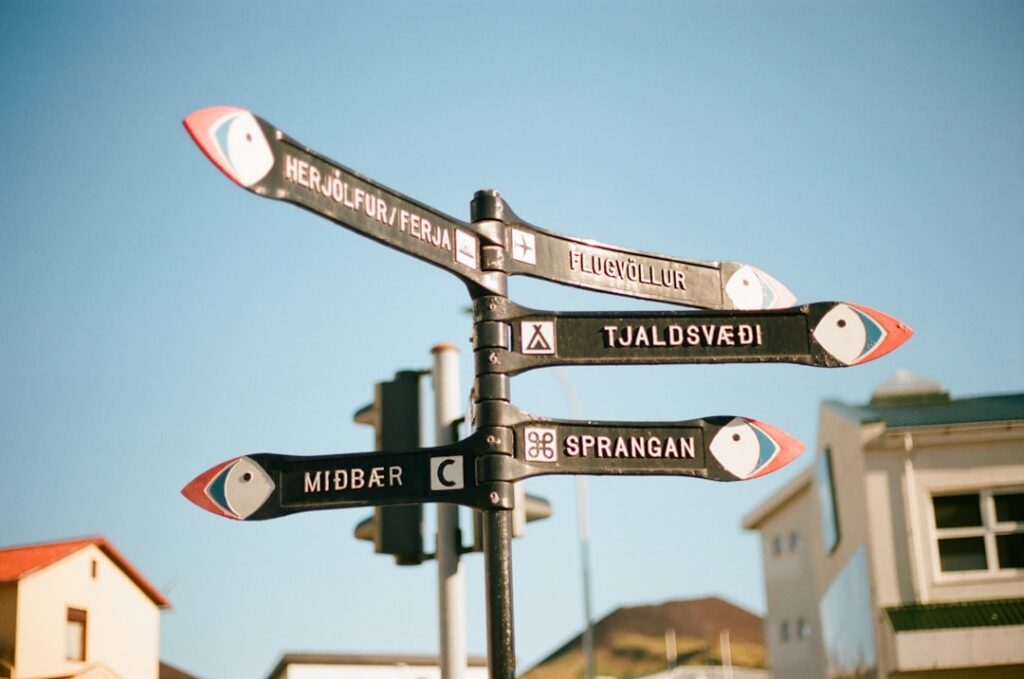
Gisting is the Icelandic word for guesthouse or accommodation, and you’ll see it on signs across the country. A few phrases help at check-in and check-out, especially outside the capital where English fluency varies a little more.
Ég á bókun (yehg ow boh-kun) — I have a booking.
Hvar er baðherbergið? (kvar air bath-hair-bair-gith?) — Where is the bathroom? The letter g before i or e often softens to a ‘y’ sound in Icelandic, which is why this sounds more fluid than it looks.
Gott kvöld (got kvuld) — Good evening. Use this when you pass reception on your way out to dinner and you’ll seem remarkably fluent to anyone who doesn’t know you.
Hlý (hlee) — Warm. Kalt (kalt) — Cold. Useful when discussing whether your room is comfortable, or when you’re outside near Gullfoss in February and someone asks how you’re doing.
Emergency and Safety Phrases
Iceland is a very safe country in terms of crime, but the landscape is genuinely dangerous if you underestimate it. Sudden weather changes, unbridged rivers, geothermal fields where the ground is thin — these are real considerations. A few words could matter.
Hjálp! (hyowlp!) — Help!
Hringið í 112 (hring-ith ee 112) — Call 112. Iceland’s emergency number. The phrase matters less than the number, but knowing both is useful.
Ég er meiðslaður / meiðsluð (yehg air meth-slath-ur / meth-sluth) — I am injured. Masculine / feminine forms respectively.
The Safetravel.is website and app are also available in English and are run by the Icelandic Association for Search and Rescue — registering your itinerary there before a highland route or a remote hike is practical advice that has nothing to do with language.
A Few Phrases That Will Actually Make People Smile
Beyond functional communication, there are phrases that exist purely in the cultural register — things that, if you say them correctly, will make the person you’re talking to genuinely laugh or warm to you immediately.
Þetta reddast (thet-a red-ast) — This will work itself out. This is essentially the Icelandic national philosophy. Things tend to sort themselves out. You might hear it said about a traffic jam, a cancelled flight, a broken heater. If you say it to an Icelander who’s dealing with a minor disaster, they will probably appreciate you more than you expect.
Gott veður (got veth-ur) — Good weather. Said with the appropriate degree of irony, this covers a lot of Icelandic social situations. What counts as good weather in Iceland is a cultural position, not a meteorological one.
Skál! (skowl) — Cheers! If you’re at a bar on Laugavegur or at someone’s kitchen table with a bottle of Brennivín, this is the word. One syllable, hard to get wrong, universally received well.
Learning More Than Just the Basics
If you want to go further before your trip, the Drops app has an Icelandic module that’s genuinely good for vocabulary building in short sessions. Pimsleur has audio courses that help with pronunciation specifically, which is where Icelandic is most demanding for English speakers. Neither requires serious time commitment — even 10 minutes a day for two weeks makes a difference you’ll actually feel when you arrive.
The bookshop Mál og Menning on Laugavegur stocks small Icelandic phrasebooks and language guides if you want something physical to carry, and the staff there are helpful about pointing you toward the right level for a tourist rather than a student.
Language learning for a trip to Iceland is never about becoming fluent. It’s about showing up with something — a greeting, a thank-you, a toast — that signals you see the place as more than a backdrop. That’s what þetta reddast is really about, actually. Make the effort, see what happens, trust it’ll come out fine.